

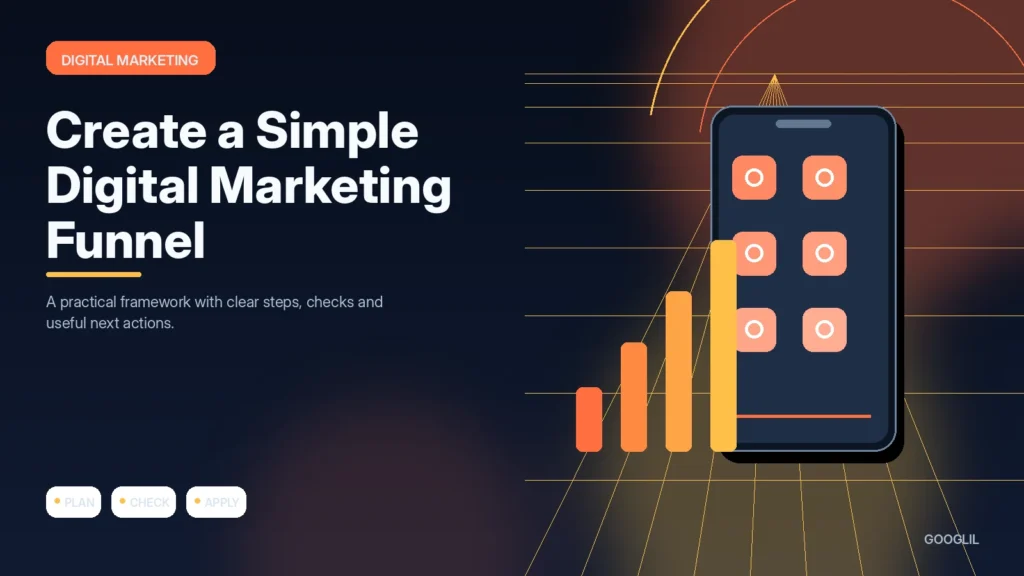
A useful funnel is a sequence from attention to a measurable action. It does not need complicated automation: one audience, one clear promise and one next step are enough to test whether the message works.
1. Define one audience
Narrow the audience enough that their problem, language and decision are clear. Marketing to “everyone” usually produces a weak message and weak measurement.
2. Choose one acquisition channel
Choose a channel where the intended audience can realistically be reached and where you can measure the next action, not simply the largest possible audience.
3. Build a focused landing page
Keep the page aligned with the promise that brought the visitor there. Remove competing actions and make evidence, objections and the primary CTA easy to scan.
4. Measure qualified actions
Track actions that show progress toward the business goal, such as a qualified enquiry, booked call, trial, purchase or newsletter signup. Traffic and clicks are useful diagnostics, but they should not be treated as the final success metric when the funnel has a deeper objective.
Connect every stage to one decision
Define who the offer is for and what problem they recognise. Choose a channel that reaches that group, send visitors to a focused page, and ask for an action proportionate to their level of trust. Track the path from source to qualified action so you can see whether the problem is traffic quality, page clarity or the offer itself.
A small service-business funnel
A local web consultant might publish a useful site-speed checklist, promote it through search or social, link to a landing page for a short audit, and measure qualified audit requests. That is enough to learn before adding email sequences, retargeting or multiple lead magnets.
Practical example
A small design agency could build a simple funnel around one service rather than every service it offers. An educational article or search ad sends qualified visitors to a landing page about website redesign, the page explains the problem and evidence, and one clear form captures project details. Track the steps from qualified visit to enquiry to closed project; raw traffic alone does not tell you whether the funnel works.
Design the funnel around one customer journey
A simple marketing funnel begins with one audience, one problem and one meaningful conversion. Map how a person first discovers the offer, what information they need before trusting it, and what action represents genuine buying intent. Avoid adding channels or automation before the core journey can be measured from first visit to enquiry or purchase.
Use acquisition content or advertising that makes a clear promise, send qualified visitors to a focused landing page, and remove distractions that compete with the primary action. Follow up with information that answers the most common objections rather than repeating the sales pitch. Define conversion events before launch so analytics can distinguish an interested visitor from a qualified lead.
- Measure cost and quality by channel; cheap clicks can be expensive if they rarely become customers.
- Keep landing-page messaging consistent with the ad, email or article that brought the visitor there.
- Use evidence such as examples, process details, guarantees or policies where they reduce legitimate uncertainty.
- Improve the weakest step first instead of rebuilding the entire funnel after one disappointing week.
Track progression between stages, qualified lead rate and final customer value. Reach and click-through rate are supporting metrics; the funnel exists to produce a useful business outcome.
What to avoid when working on a digital marketing funnel
- Tracking vanity metrics only.
- Using too many channels at once. Simplify to one primary approach first, prove it works, then add complexity only for a clear reason.
- Weak calls to action.
Quick checklist for a digital marketing funnel
- Define one audience.
- Choose one acquisition channel.
- Build a focused landing page.
- Measure qualified actions.
Design the funnel around one customer journey
A simple marketing funnel begins with one audience, one problem and one meaningful conversion. Map how a person first discovers the offer, what information they need before trusting it, and what action represents genuine buying intent. Avoid adding channels or automation before the core journey can be measured from first visit to enquiry or purchase.
Use acquisition content or advertising that makes a clear promise, send qualified visitors to a focused landing page, and remove distractions that compete with the primary action. Follow up with information that answers the most common objections rather than repeating the sales pitch. Define conversion events before launch so analytics can distinguish an interested visitor from a qualified lead.
- Measure cost and quality by channel; cheap clicks can be expensive if they rarely become customers.
- Keep landing-page messaging consistent with the ad, email or article that brought the visitor there.
- Use evidence such as examples, process details, guarantees or policies where they reduce legitimate uncertainty.
- Improve the weakest step first instead of rebuilding the entire funnel after one disappointing week.
Track progression between stages, qualified lead rate and final customer value. Reach and click-through rate are supporting metrics; the funnel exists to produce a useful business outcome.
Frequently asked questions
Do I need marketing automation software?
No. Start with the smallest trackable flow. Add automation when manual follow-up becomes a real bottleneck.
Which metric matters most?
Use the metric closest to the business outcome, such as qualified enquiries, booked calls or purchases, while using clicks and reach as supporting signals.
Where should I improve a weak funnel first?
Find the largest drop between stages and review the message, audience and friction there before adding more traffic.
Keep Learning
Continue with these related guides: